
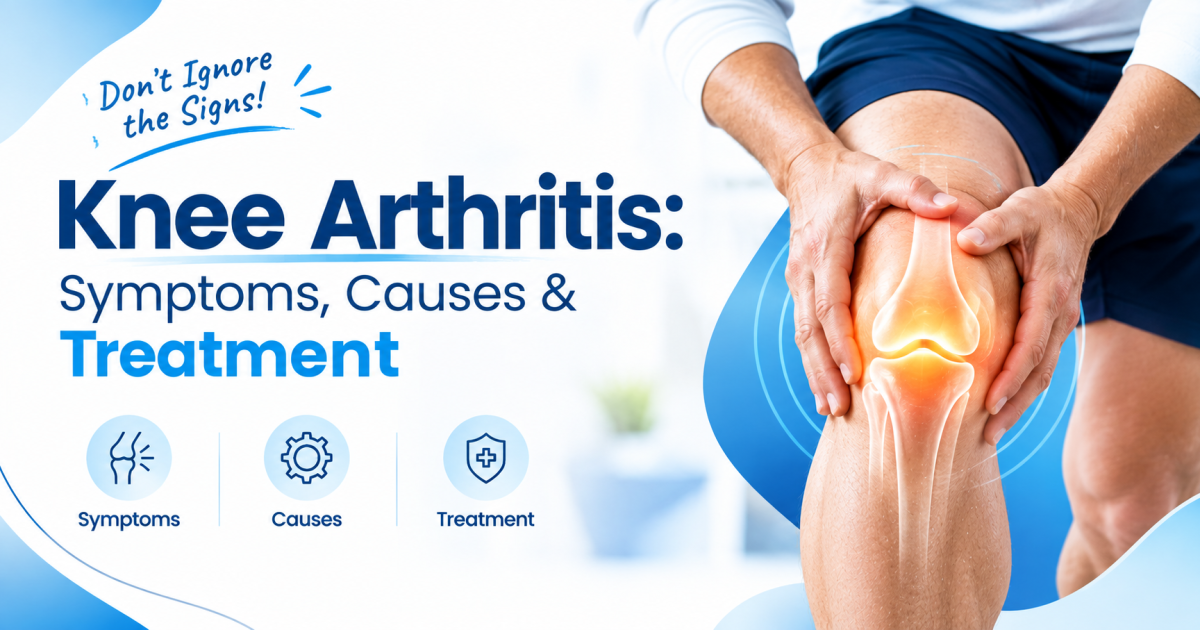
Learn about knee arthritis symptoms, causes, diagnosis and treatment options, including physiotherapy and knee replacement, and know when to consult an orthopaedic doctor.
If your
knees have started complaining more than they used to — a little stiffness when
you get up in the morning, some soreness after a long day on your feet — you're
not alone. Knee arthritis is one of the most common reasons people visit an
orthopaedic doctor, and it tends to creep in gradually rather than announce
itself all at once. Understanding what's happening in the joint, and knowing
what your options actually are, makes it a lot easier to deal with.
Arthritis
simply means inflammation of a joint, and the knee happens to be one of the
joints most prone to it. The most common form is osteoarthritis, which develops
when the cartilage that cushions the ends of your thigh bone and shin bone
gradually wears down. Cartilage doesn't have its own blood supply, so once it
starts breaking down, the body isn't great at repairing it on its own. As the
cushioning thins out, bones can start rubbing closer together, which is what
causes the pain, stiffness and swelling people associate with the condition.
There are other types too — rheumatoid arthritis, for instance, is an
autoimmune condition — but osteoarthritis of the knee is by far the one most
people mean when they talk about "knee arthritis."
Early Symptoms of Knee Arthritis:
The tricky
part about knee arthritis is that early on, the symptoms are easy to brush off.
A bit of stiffness after sitting for a while, a dull ache after walking longer
than usual, occasional swelling around the joint — these can all seem minor.
Some people notice a grinding or clicking sensation when they bend the knee.
Others find that the joint feels stiff first thing in the morning but loosens
up once they've been moving around for a bit. None of this is usually alarming
on its own, which is exactly why so many people wait months, sometimes years,
before getting it checked.
Age is
the biggest factor — cartilage naturally wears with years of use, so risk goes
up as people get older. But it's not just about age. Extra body weight puts additional
load on the knee joint with every step, which speeds up wear. Previous
injuries, including ligament tears or fractures around the knee, can also set
the stage for arthritis later in life, even if the injury healed well at the
time. Genetics play a role too; if arthritis runs in your family, your own risk
tends to be a bit higher. Jobs or activities involving repetitive kneeling,
squatting, or heavy lifting can add to the wear over time, and conditions like
gout or rheumatoid arthritis can also affect the knee joint.
As the
cartilage wears down, everyday movements that used to be automatic start
needing a bit more thought. Walking longer distances can become tiring or
uncomfortable. Climbing stairs — especially going down, which puts more
pressure through the knee — often becomes the first activity people struggle
with. Getting up from a low chair or the floor can start to feel stiffer and
require pushing off with the arms. None of this happens overnight, and that
gradual pace is often what makes people underestimate how much the knee has
actually changed.
When Should You See an Orthopaedic Doctor?
There's
no fixed rule about exactly when to seek help, but a few signs are worth paying
attention to. If knee pain is sticking around for more than a few weeks, if
it's affecting how you walk or sleep, if the joint feels swollen or warm, or if
you're finding yourself avoiding stairs or certain activities because of
discomfort, it's a reasonable time to get it looked at. Catching arthritis
earlier generally gives you more options and can help slow how quickly symptoms
progress.
How Is Knee Arthritis Diagnosed?
Diagnosis
usually starts with a conversation about your symptoms and daily activities,
followed by a physical examination to check the knee's range of motion,
stability and any swelling or tenderness. An X-ray is typically the next step,
since it shows how much joint space has narrowed and whether there are bone
changes typical of arthritis. In some cases, an MRI may be used to get a more
detailed look at the cartilage and surrounding soft tissue, particularly if the
picture isn't clear from the X-ray alone.
Treatment Options for Knee Arthritis:
Treatment
almost always starts conservatively. For many people, especially in the earlier
stages, simple changes make a real difference — adjusting activities that
aggravate the knee, working on weight management where it's relevant, and using
pain relief under a doctor's guidance rather than self-medicating.
Physiotherapy is often a central part of this stage, since strengthening the
muscles around the knee, particularly the quadriceps, helps take some of the
load off the joint itself and can improve stability and flexibility.
If
symptoms persist despite these measures, a doctor may consider other options
such as injections to reduce inflammation or support joint lubrication, or
bracing to help with alignment and support during activity. These aren't right
for everyone, and whether they're worth trying depends on the severity of the
arthritis, how much it's affecting daily life, and the person's overall health.
When Is Knee Replacement Considered?
Surgery
isn't the starting point for knee arthritis, and it isn't necessary for
everyone. It tends to become a realistic conversation when arthritis has
advanced significantly, when pain is persistent despite non-surgical treatment,
and when the condition is clearly limiting mobility and quality of life. Knee
replacement involves resurfacing the damaged parts of the joint, and the
decision to go ahead with it depends on factors like age, activity level, the
extent of joint damage, and general health — it's a decision made jointly
between patient and doctor, not a default step.
Managing
early arthritis is largely about slowing progression and staying active safely,
while advanced arthritis is more about restoring function once conservative
measures aren't giving enough relief. The two stages call for genuinely
different approaches, which is part of why an accurate diagnosis early on
matters.
Orthopaedic Care at AmorHospitals:
Amor
Hospitals, based in Kukatpally, Hyderabad, offers orthopaedic care as part of
its broader range of specialities, including joint replacement services for
patients dealing with conditions such as knee arthritis. For someone navigating
knee pain, having orthopaedic evaluation, diagnostics and treatment planning
available under one roof can make the process of getting assessed and following
through on a treatment plan more straightforward.
Can Knee Arthritis Be Prevented?
You can't
always prevent arthritis entirely, especially if genetics or past injuries are
involved, but a few habits help protect your knees over time. Maintaining a
healthy body weight reduces the load on the joints. Regular, low-impact
exercise like walking, cycling or swimming keeps the muscles around the knee
strong without excessive strain. Avoiding prolonged periods of inactivity,
using good form during exercise, and not ignoring minor knee injuries when they
happen all add up over the years.
Knee
arthritis is common, but it isn't something you have to just live with quietly.
If your knees have been bothering you for a while, getting it checked by an
orthopaedic doctor is a reasonable next step — the earlier it's looked at, the
more options you typically have.
FAQs:
1. Is knee arthritis the same as normal wear and tear from ageing?
Not exactly. Some cartilage thinning is a normal part of ageing, but knee
arthritis is when that wear progresses enough to cause pain, stiffness and
reduced movement. Not everyone with age-related changes develops symptomatic
arthritis, and not everyone with arthritis is elderly.
2. Can young people get knee arthritis?
Yes. While it's more common with age, previous injuries, joint overuse,
obesity, or genetic factors can lead to arthritis symptoms appearing earlier in
life.
3. Does knee arthritis always get worse over time?
It often progresses gradually, but the rate varies a lot from person to person.
Staying active appropriately, managing weight, and following medical advice can
help slow how quickly symptoms develop.
4. Is walking good or bad for knee arthritis?
For most people, moderate walking is actually helpful, since it keeps the
muscles around the knee strong without putting excessive strain on the joint.
That said, how much and what kind of activity suits you depends on your
specific condition, so it's worth discussing with a doctor.
5. Do I need surgery if I've been diagnosed with knee arthritis?
No, not necessarily. Most people start with non-surgical treatment — activity
changes, physiotherapy, weight management and pain relief under guidance.
Surgery is only considered when arthritis is advanced or symptoms don't improve
with conservative care.
6. What's the difference between osteoarthritis and rheumatoid
arthritis in the knee?
Osteoarthritis is caused by gradual wear of the cartilage, usually linked to age,
injury or joint stress. Rheumatoid arthritis is an autoimmune condition where
the body's immune system attacks the joint lining, and it can affect people at
a younger age and often involves multiple joints.
7. Can diet affect knee arthritis?
Diet doesn't cure arthritis, but maintaining a healthy weight through diet can
reduce the load on the knee joint, which may help with symptoms over time.
8. How long does it take to recover after knee replacement surgery?
Recovery time varies from person to person depending on overall health, the
extent of surgery, and how well rehabilitation is followed, so it's best
discussed directly with your treating doctor rather than assuming a fixed
timeline.