
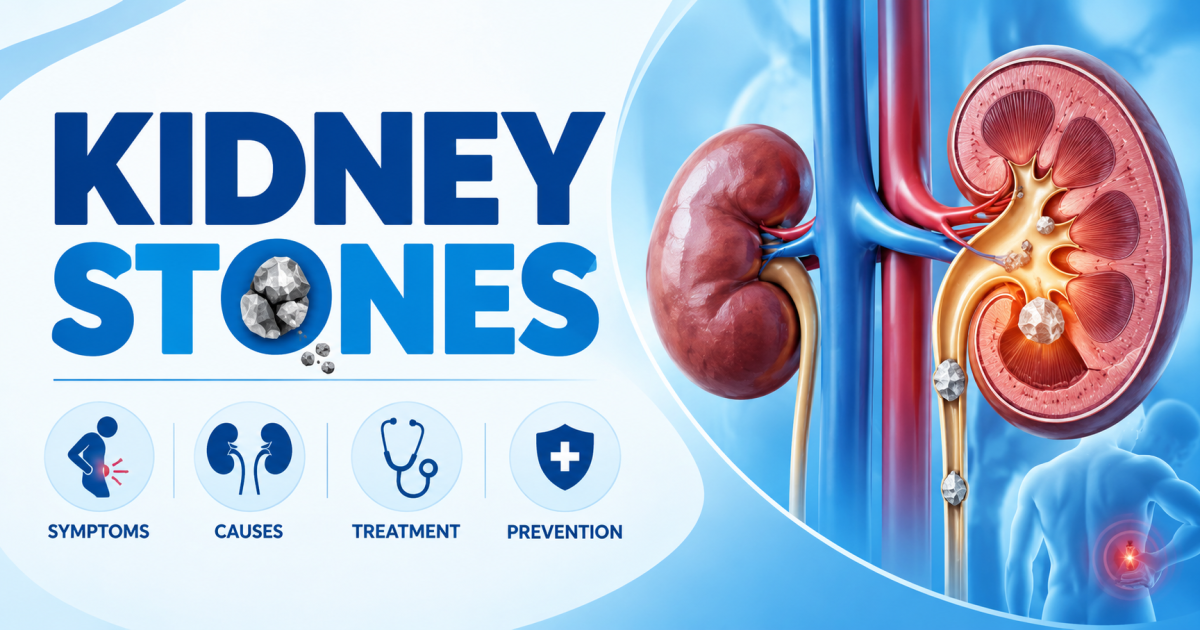
Kidney stones can cause sudden and severe pain, especially in the back, side, or lower abdomen. This blog explains the common symptoms, causes, treatment options, and simple prevention tips to help you understand kidney stones and protect your kidney health.
You're bent over, one hand pressed into your lower back, wondering
if you pulled a muscle, if it's gas, or if it's something worse. Then the pain
shifts — it starts creeping toward your stomach or groin, and it won't let up
no matter how you sit or lie down. This is roughly how most people first meet a
kidney stone. Nobody plans for it, and almost nobody recognises it right away.
So let's get into what's actually going on inside your body when
this happens, what to look out for, and what the treatment path generally looks
like.
Your kidneys are constantly filtering your blood, pulling out
waste and extra minerals, and sending them out as urine. Normally, everything
stays dissolved and flows out without any drama. But when urine has too little
water and too much of certain substances — calcium, oxalate, uric acid, and a
few others — these substances can start clumping together. Over time, that
clump hardens into what we call a kidney stone.
Some stay small, like a grain of sand, and you'd never even know
they existed. Others grow larger and get stuck somewhere along the urinary
tract, usually in the ureter — the thin tube that carries urine from the kidney
down to the bladder. That's when things get painful.
What Are the Symptoms of
Kidney Stones?
Kidney stone symptoms depend a lot on the size of the stone and
exactly where it's sitting. A tiny stone in the kidney might cause nothing at
all. But once it starts moving, here's what people typically notice:
- Sudden, intense pain in the side or back, usually below the ribs
- Pain that shifts toward the lower abdomen or groin as the stone
travels down
- Pain that comes in waves — sharp for a while, then easing, then
sharp again
- A burning feeling or pain while urinating
- Needing to urinate often, even when barely anything comes out
- Blood in urine, which can look pink, red, or brownish
- Nausea or vomiting alongside the pain
- Cloudy or bad-smelling urine
- Fever and chills, which can point to an infection sitting
alongside the stone
If you're only experiencing mild discomfort, it could still be a
stone. If you're doubled over in pain with fever, that's a different situation
altogether — more on that below.
There's almost never a single cause. It's usually a combination of
habits and, sometimes, things you can't fully control. Common kidney stone
causes and risk factors include:
- Not drinking enough water through the day
- Eating too much salt, which pushes more calcium into your urine
- Diets heavy in animal protein or oxalate-rich foods
- A family history of kidney stones
- Having had a stone before — it raises your odds of getting
another
- Being overweight
- Certain medical conditions, like gout or some digestive
disorders
- Some long-term medications and supplements
- Naturally high levels of calcium, oxalate, or uric acid in your
urine
None of this means you did something wrong if you've developed a
stone. Some people just have body chemistry that leans this way.
Types of Kidney Stones:
Not all stones are made of the same material, and the type often
shapes how prevention advice is given.
Calcium stones — the most common type, usually a mix of calcium
with oxalate or phosphate.
Uric acid stones — often linked to a high-protein diet or gout.
Struvite stones— these tend to form after certain urinary
infections and can grow surprisingly fast.
Cystine stones — a rarer, inherited type where the kidneys leak
too much of a substance called cystine.
How Are Kidney Stones Diagnosed?
If a stone is suspected, doctors usually rely on a mix of:
Urine tests: to check for blood, infection, or crystals
Blood tests: to look at kidney function and mineral levels
Ultrasound: often the first imaging test used since it avoids radiation
CT scan: which gives a much sharper picture of the stone's exact size and position when more detail is needed
The right combination depends on your symptoms and history — there's no one-size-fits-all test order.
Here's the thing about kidney stone treatment — it's never really
a fixed formula. It depends on the size of the stone, where it's sitting,
whether it's blocking urine flow, whether there's an infection, and your
overall health. Your doctor works all of this out before deciding on next
steps.
For smaller stones, treatment is often fairly simple:
- Drinking enough fluids to help the stone move down and pass
naturally
- Pain relief prescribed by a doctor to get you through the
discomfort
- Sometimes, medication that relaxes the ureter to help the stone
pass more easily
Many stones do pass on their own this way, given time.
But when a stone is too large, stuck, or causing repeated pain,
infection, or a blockage, a procedure may be recommended. This doesn't mean
every patient needs surgery — far from it — but when it is needed, here are the
common approaches:
Shockwave lithotripsy (ESWL)— sound waves delivered from
outside the body break the stone into smaller fragments that pass out more
easily.
Ureteroscopy (URS)— a thin scope is passed through the
urinary tract to reach the stone directly, often combined with laser
lithotripsy to break it up.
Laser lithotripsy— a laser fibre is used through the scope
to fragment the stone into pieces small enough to pass or remove.
PCNL (percutaneous nephrolithotomy)— used for larger
stones, this involves a small cut in the back to access and remove the stone
directly from the kidney.
Minimally invasive stone removal— a broad term covering
scope-based and keyhole techniques that avoid large open cuts and generally
allow faster recovery.
Which of these applies to you is something only your urologist can
decide after reviewing your scans.
Some symptoms need attention right away rather than a wait-and-see approach. Reach out to a doctor if you notice:
- Pain that's severe or steadily getting worse
- Fever or chills along with the pain
- Difficulty passing urine, or passing very little
- Visible blood in your urine
- Repeated vomiting
- Signs of a urinary infection — burning, cloudy urine, or fever
Severe pain combined with fever or trouble urinating isn't
something to sit on. It can mean a stone is blocking urine flow along with an
infection behind it, and that needs prompt medical care.
How to Prevent Kidney Stones:
Prevention isn't glamorous, but it works over time. A few things genuinely help:
- Drink enough fluids through the day — pale yellow urine is
usually a good sign you're doing this right
- Cut back on excess salt in everyday meals, including pickles and
packaged snacks
- Eat a balanced diet instead of cutting out entire food groups on
a whim
- Avoid sudden, extreme dietary changes without checking with a
doctor first
- Keep your weight in a healthy range through regular activity
- If you've had a stone before, follow your doctor's specific
advice, since prevention often depends on the exact type of stone you formed
There's no home remedy, drink, or food that's proven to reliably
dissolve an existing stone, so it's best not to rely on those instead of proper
evaluation.
Kidney Stone Treatment at Amor Hospitals:
If you're looking for a kidney stone doctor or urologist for kidney stones in Hyderabad, the Nephrology & Urology department at Amor Hospitals in Kukatpally handles kidney and ureteric stone management as part of its broader kidney and urinary care services.
The department offers a mix of medical management and minimally
invasive stone removal options, including PCNL, ureteroscopy (URS), shockwave
lithotripsy, and laser lithotripsy — with the choice of approach based on the
size, location, and nature of the stone. Diagnosis is supported through urine
analysis, blood tests, and imaging, and the team also manages related
conditions like recurrent UTIs and general kidney and urinary tract disorders.
If you're dealing with kidney stone symptoms and want it properly
evaluated, this is the kind of care to look for — a team that can diagnose
accurately and walk you through the treatment options suited to your case.
Frequently Asked Questions:
**What
does kidney stone pain feel like?**
Most
people describe it as a sharp, cramping pain that comes in waves — starting in
the back or side and moving toward the lower belly or groin as the stone shifts
position.
**Can
a kidney stone pass on its own?**
Often,
yes, especially if it's small. Larger stones or ones causing a blockage usually
need medical treatment.
**How
long does it take for a kidney stone to pass?**
It
varies quite a bit — anywhere from a few days to a few weeks, depending on the
size and position of the stone. Your doctor can give you a better estimate
based on your scans.
**What
causes kidney stones?**
Low
water intake, high salt diets, certain foods, family history, and some medical
conditions are among the most common causes.
**When
is kidney stone surgery needed?**
Generally
when a stone is too large to pass on its own, is causing a blockage, repeated
infections, or pain that isn't settling with medication alone.
**How
are kidney stones removed?**
Depending
on the case, through natural passage with fluids, or procedures like shockwave
lithotripsy, ureteroscopy with laser lithotripsy, or PCNL for larger stones.
**Can
kidney stones come back?**
Yes,
unfortunately they can, especially without preventive changes. That's why
doctors often recommend follow-up and lifestyle adjustments after a stone
episode.
**How
can I prevent kidney stones?**
Drinking
enough water, cutting back on excess salt, eating a balanced diet, and
following your doctor's advice if you've had a stone before are the main things
that help.
Conclusion:
Kidney stones are painful, sometimes frightening, but in most
cases manageable once properly diagnosed. The size and location of the stone,
along with your symptoms and overall health, decide what treatment path makes
sense — and that decision is best left to a nephrologist or urologist who's
actually looked at your reports. If you're experiencing persistent pain, fever,
or blood in urine, don't wait it out or try to fix it with home remedies. Get
it checked. Early evaluation usually makes the whole experience a lot less
stressful.