
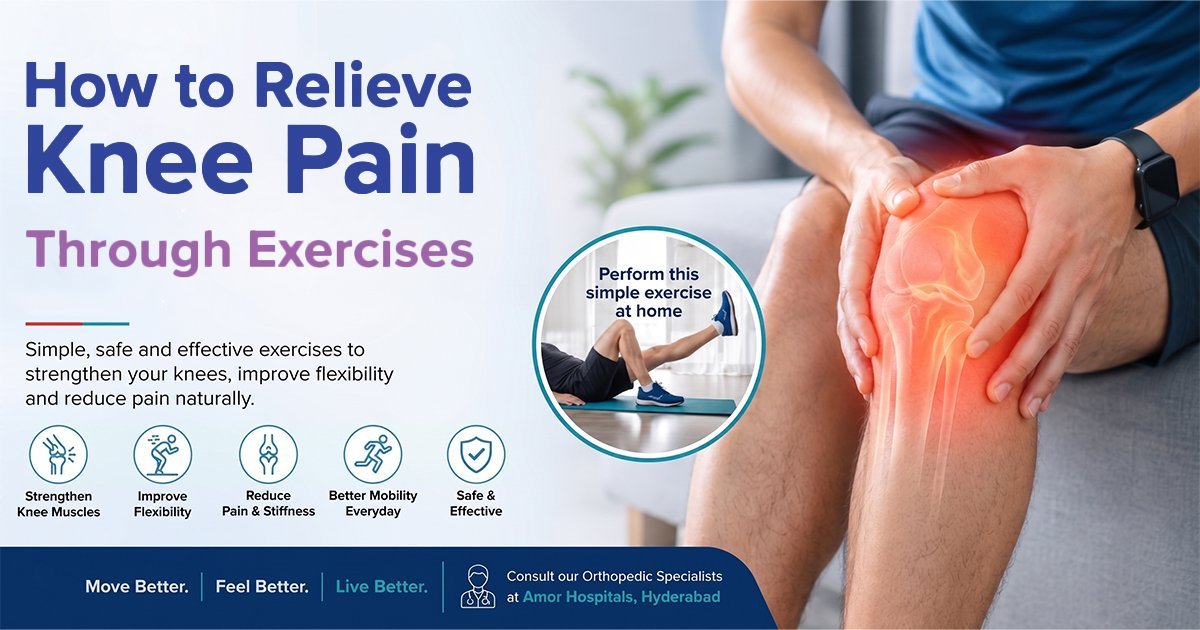
A practical guide to relieving knee pain through targeted, low-impact exercises — covering causes, the best strengthening and stretching moves, what to avoid, and when to see an orthopedic specialist in Hyderabad.
Praveen
used to take the stairs two at a time. These days, he pauses at the bottom of
the staircase in his Kukatpally apartment complex a second longer than he'd
like to admit. Two floors up, his knees start talking — a dull ache behind the
kneecap that doesn't settle until he sits down. He's forty-four, not
overweight, not injured as far as he knows, yet stairs have quietly become a
daily negotiation.
A few
kilometers away in Miyapur, Lakshmi Devi has quietly stopped her morning walk
around the park. She tells her neighbours she's "just tired," easier
than admitting her right knee swells past ten minutes. And in Hitech City, a
twenty-six-year-old engineer stands up after a long call and feels his knee
catch before it loosens. He assumes it's nothing — he's young, it'll sort
itself out.
These
three have almost nothing in common except this: none of them are doing
anything about their knee pain, though all three could likely feel noticeably
better within weeks if they started. That's what this guide is about — not
surgery, not a miracle cure, but a clear look at how the right exercises, done
consistently, ease knee pain and rebuild the strength that supports the joint.
Knee pain
isn't one condition. It's a symptom that can come from several structures
inside a joint that does an enormous amount of work with little appreciation.
The knee is where the thigh bone meets the shin bone, cushioned by cartilage,
held together by ligaments, and supported by the quadriceps and hamstrings
around it. Pain can come from thinning cartilage, a strained ligament,
inflammation in the joint lining, or muscles too weak to support it properly.
Some
people feel a sharp twinge going down stairs. Others carry a dull ache worse in
the morning that eases through the day. Some notice grinding when they bend the
knee, others swelling after a long day on their feet. Recognising the pattern
is often the first step toward knowing what will actually help.
Why Knee Pain Happens:
Every
step, every stair, every time you stand up from a chair, your knees absorb a
share of your body weight — several times that if you're running. Over years
this adds up, and if the surrounding muscles aren't strong enough to share the
burden, the joint takes on more strain than it was built to handle alone.
Add the
modern habit of long hours sitting — at a desk, in traffic, on a couch — and
you get joints that barely move most of the day, then face sudden demands like
a flight of stairs. Muscles that aren't used regularly weaken fast, and weak
muscles around the knee mean the joint absorbs more direct impact with every
movement, one of the quieter reasons knee pain has become common even among
people who aren't athletes.
Sports
injuries, particularly ligament sprains and meniscus tears, are frequent among
weekend cricket and badminton players who skip a proper warm-up. Muscle
weakness, especially in the quadriceps, is an underrated cause, since these
muscles act like a natural brace for the joint. Long hours of sitting lead to
stiffness that shows up the moment you stand and walk, while extra body weight
multiplies the load with every step. Osteoarthritis, the gradual thinning of
cartilage, becomes increasingly common from the forties onward, and old
injuries that were never fully rehabilitated tend to resurface as chronic pain
years later.
Who Is More Likely to Develop Knee Pain?
Office
workers who sit for long stretches often develop stiffness that later shows up
as pain. Elderly individuals face a natural decline in cartilage thickness and
muscle mass, reducing the knee's ability to absorb shock. Athletes and weekend
sports players stress ligaments and cartilage repeatedly, particularly with
sudden direction changes. People carrying extra weight load their knees
proportionally more with every step, and anyone with a previous knee injury
carries a somewhat higher risk of recurring pain, even if it seemed to heal
fully.
Can Exercise Really Help?
This is
usually the first question people ask, and it's fair, because the instinct when
something hurts is to rest it completely. With knee pain, that instinct can
work against you: prolonged inactivity lets the supporting muscles weaken
further, so the joint ends up carrying more load than it was ever meant to bear
alone.
The right
kind of exercise works the other way. It strengthens the muscles stabilising
the knee, improves flexibility in the surrounding tissue, and increases blood
flow, which supports healing and reduces stiffness. This doesn't mean every
movement helps, or that pushing through significant pain is wise — it means
structured, low-impact movement, chosen carefully and increased gradually, is
one of the most effective tools for reducing knee pain, often more so than rest
alone.
How Exercise Strengthens the Knee:
The joint
itself doesn't have much say in how well it's protected; that job largely falls
to the quadriceps and hamstrings around it. When these muscles are strong, they
absorb a meaningful share of the impact that would otherwise land directly on
the cartilage and ligaments, building a better support system so the joint
structures do less work on their own.
Flexibility
exercises play a complementary role. Tight hamstrings, calves, or quadriceps
pull unevenly on the knee, altering how it moves and increasing strain in specific
spots, so stretching regularly lets the knee move with less resistance.
Low-impact cardio, like walking or cycling, adds another layer, improving
circulation and helping maintain a healthy weight, both of which reduce the
overall load the knee carries.
When Exercise Can Make Pain Worse:
Worth
being honest about this before getting into specific exercises: the wrong
movement, or the right one done incorrectly, can set someone back. High-impact
activities like running on hard surfaces, jumping, or deep squatting send
sudden, concentrated stress through the joint that can aggravate inflammation
or irritate damaged cartilage. Pushing through sharp or worsening pain, rather
than staying within a comfortable range, usually means the movement is doing
more harm than good. Skipping a warm-up or ignoring early swelling can also
turn something manageable into something bigger. Mild discomfort during gentle
strengthening is generally fine; sharp pain, swelling afterward, or a sense of
instability is a sign to stop and reassess.
The Best Exercises for Knee Pain Relief:
The
exercises below are widely used in physiotherapy for knee pain because they
build strength and flexibility without loading the joint the way high-impact
movement does. Start gently and stay consistent, letting your knee's response
guide your pace.
- Straight Leg Raises — strengthen the quadriceps
without bending the knee, making them safe even for painful or swollen
knees. Lie on your back, bend one knee with the foot flat, keep the other
leg straight, tighten the thigh, and lift it to the height of the bent
knee, hold briefly, then lower with control. 10–15 reps per side.
- Heel Slides — build flexibility, gently
taking the knee through its bending range; suit people whose knees feel
stiff in the morning. Lying on your back, slide one heel toward your
buttocks as far as comfortable, then slide it back out. 10–15 reps per
leg.
- Seated Knee Extensions — add resistance through
range of motion, useful for rebuilding the strength needed to stand or
climb stairs. Seated with feet flat, straighten one leg until roughly
parallel to the floor, hold, then lower with control. 10 reps per leg.
- Wall Squats — strengthen the quadriceps
and glutes through a partial range, using the wall for support. Back
against the wall, slide into a shallow squat with knees over the ankles,
hold ten seconds, slide back up.
- Walking — one of the simplest, most
underrated tools here: low-impact, free, and moving the joint through its
natural range. Start with 10–15 minutes on a flat surface and build up
gradually with supportive, cushioned footwear.
- Cycling — especially on a
stationary bike, combines cardio benefit with strengthening and almost
none of the impact of running. Begin with low resistance for 15–20 minutes
a few times a week.
- Hamstring Stretch — keeps this muscle group
flexible, easing strain off the back of the knee. Sit with one leg
extended, the other bent, lean forward gently until you feel a mild
stretch, hold 20–30 seconds, repeat three times per leg.
- Calf Stretch — influences how the lower
leg absorbs impact while walking, which indirectly affects the knee.
Facing a wall, step one foot back, keep it straight with the heel down,
and lean forward. Hold 20–30 seconds each side.
- Quadriceps Stretch — balances the hamstring
work, since tight quads pull unevenly on the kneecap. Standing near a
wall, bend one knee and bring the heel toward your buttocks. Hold 20–30
seconds per side.
- Mini Step-ups — build functional strength
for climbing stairs, suiting people past the earliest rehab stage. On a
low, sturdy step, step up leading with one foot, then step down with
control. 8–10 reps per leg.
- Bridges — target the glutes and hamstrings;
strong hips help stabilise the knee while walking. Lying on your back with
knees bent, feet flat, lift the hips by squeezing the glutes, hold
briefly, lower slowly. 10–15 reps.
- Side Leg Raises — strengthen the outer hip
muscles that control how the knee tracks while walking. Lying on your side
with legs stacked straight, lift the top leg without rotating the hip
forward. 10–15 reps per side.
Not every
movement helps when your knees are already painful, and some can genuinely make
things worse. Jumping exercises send a sudden shock through the joint that a
compromised knee often can't absorb. Running on hard surfaces adds repetitive
high impact to cartilage already under stress. Deep squats, particularly below
ninety degrees, significantly increase pressure behind the kneecap, and heavy
lunges place a similar concentrated load. High-impact aerobics, with quick
direction changes and repeated jumping, is a common culprit behind flare-ups in
people who otherwise exercise regularly. None of these are permanently
off-limits, but they're best avoided during a painful phase and reintroduced
carefully once strength improves.
Daily Lifestyle Changes That Support Knee Health:
Exercise
alone rarely tells the whole story. A few daily habits, practiced consistently,
make a real difference.
Weight
management matters
more than most people expect, since every extra kilogram adds roughly four
times that load to the knee with each step. Proper footwear plays a
bigger role than it's usually given credit for — worn-out soles transfer more
shock directly to the knees. Nutrition for healthy joints rounds out the
picture: calcium and vitamin D support bone strength, omega-3s have some
anti-inflammatory benefit, and adequate protein supports the muscle repair
strengthening work depends on.
When Should You Stop Exercising? Warning Signs
Exercise
should generally leave you feeling looser and stronger over time, not worse.
Mild discomfort during strengthening work is normal, particularly early on, but
there's a clear difference between that and pain signalling something's wrong.
Stop and reassess if you notice sharp or shooting pain during a movement,
swelling that appears or worsens afterward, a sense of the knee giving way, or
pain persisting more than a day or two.
When Should You Visit an Orthopedic Doctor?
Most mild
to moderate knee pain responds well to the exercises and lifestyle changes
above, but certain patterns deserve a proper medical evaluation: pain lasting
more than two to three weeks without improvement, swelling that doesn't go down
with rest and ice, a knee that feels unstable or gives way, difficulty bearing
weight, or pain severe enough to interfere with sleep. A recent fall, twist, or
direct impact also warrants prompt evaluation, since some injuries look minor
at first but involve ligament or cartilage damage.
If any of
this sounds familiar, it's worth getting evaluated by the specialists at Amor
Hospitals' Orthopaedics & Joint Care department, which handles
everything from sports injuries and fractures to arthritis and joint
replacement under one roof in Kukatpally.
How Knee Pain Is Diagnosed:
Diagnosis
typically starts with a physical examination, checking range of motion,
stability, and any swelling or tenderness, alongside a discussion of when the
pain started and what makes it better or worse. An X-ray is usually the first
step, useful for assessing joint space narrowing linked to arthritis and ruling
out bone issues. If a ligament tear or other soft tissue damage is suspected,
an MRI shows structures an X-ray can't, and in some cases blood tests help rule
out inflammatory or autoimmune causes.
Treatment Options Beyond Exercise:
Exercise
plays a central role in managing knee pain, but it isn't always the whole
answer.
- Physiotherapy tailors a program to the
specific cause and severity of your pain, often adding manual therapy and
progressing the routine as strength improves.
- Medication, including
anti-inflammatories and pain relievers, helps manage discomfort during
flare-ups but doesn't address the underlying cause.
- PRP (platelet-rich plasma)
therapy
injects a concentrated preparation of a patient's own platelets into the
affected area to support natural healing, considered for certain cases of
early arthritis or tendon-related pain.
- Arthroscopy is a minimally invasive
procedure used to diagnose and treat problems like a torn meniscus through
small incisions, allowing faster recovery than open surgery.
- Knee replacement becomes a consideration
when arthritis has progressed to the point where the joint's surfaces are
too damaged to function well and conservative treatment no longer helps.
Amor
Hospitals' orthopaedics team covers this entire spectrum —
from joint replacement and arthroscopy & sports medicine to trauma,
fracture care, and structured physiotherapy — with integrated rehabilitation
pathways for each.
How Amor Hospitals Helps Patients With Knee Pain:
Amor Hospitals,
located in Kukatpally, brings together experienced orthopedic specialists and
physiotherapists who build treatment plans around each patient's specific
condition rather than a generic approach to knee pain. The diagnostic process
combines a thorough clinical examination with appropriate imaging, so any
recommended exercise or treatment plan is based on a clear understanding of
what's actually causing the discomfort.
For
patients whose pain responds well to conservative management, the physiotherapy
team guides a structured, progressive exercise program, adjusting intensity as
strength improves. For those needing more advanced intervention — from PRP
therapy to arthroscopic procedures to joint replacement — Amor
Hospitals' orthopaedic and surgical infrastructure supports the full
range of care, with a dedicated rehabilitation setup for recovery. For
residents across Kukatpally, KPHB, Miyapur, Nizampet, and nearby Hyderabad,
that means comprehensive knee care from first consultation through full
recovery, without travelling across the city.
Moving Forward With Stronger, Healthier Knees:
Knee pain
has a way of quietly shrinking someone's world, one skipped walk or avoided
staircase at a time, without ever announcing itself as a serious problem. The
encouraging part is that for most people, that trajectory can be reversed with
consistent, well-chosen exercise, a few practical lifestyle adjustments, and
the patience to let strength rebuild gradually.
Praveen,
Lakshmi Devi, and that software engineer in Hitech City aren't dealing with
anything unusual. They're dealing with knees that have gone too long without
the right support, and in most cases, that's fixable. If your knee pain has
lasted more than a couple of weeks, keeps coming back, or hasn't responded to
what you've tried on your own, it's worth having it properly evaluated by an
orthopedic specialist at Amor Hospitals in Kukatpally.
Frequently Asked Questions:
1. Can
exercise really reduce knee pain, or does it just help temporarily? For most people with mild to
moderate pain, especially from muscle weakness or early arthritis, regular
exercise produces lasting improvement, since it addresses the underlying lack
of support around the joint.
2. Which
exercises are best for knee arthritis specifically? Low-impact options like straight
leg raises, wall squats, walking, and cycling work well, strengthening
supporting muscles without high-impact stress on already-worn cartilage.
3. How
long does it take to see results from knee strengthening exercises? Most people notice less
stiffness within two to three weeks; meaningful strength gains and more
significant pain reduction typically take six to eight weeks.
4. Is it
safe to exercise if my knee is swollen? Gentle, non-weight-bearing exercises like straight
leg raises may still be fine with mild swelling, but noticeable or worsening
swelling warrants a pause and evaluation.
5. Can I
do these exercises at home without a physiotherapist? Many are safe to start at home,
but if pain is significant or your form is uncertain, a session with a
physiotherapist helps ensure you're doing them correctly.
6. How
often should I do knee strengthening exercises each week? Most people benefit from four to
five sessions a week, with one or two rest days for the muscles to recover.
7. Are
walking and cycling enough on their own, or do I need strengthening exercises
too? Both are
excellent for joint health and circulation, but pairing them with targeted
strengthening like straight leg raises and bridges gives more complete support.
8. What's
the difference between muscle soreness and harmful knee pain during exercise? Muscle soreness feels like dull,
general fatigue in the thigh or hip that eases within a day; harmful knee pain
is sharper, localised to the joint, and often paired with swelling or
instability.
9. Can
losing weight really make a noticeable difference to knee pain? Yes. Every extra kilogram adds
several times that load with each step, so even modest, sustainable weight loss
meaningfully reduces pressure on the joint over time.
10. When
do knee exercises stop being enough, and I should consider medical treatment? If pain persists or worsens
despite weeks of consistent, correctly performed exercise, or you notice
swelling, instability, or difficulty bearing weight, it's time for a proper
orthopedic evaluation at Amor Hospitals.
Amor Hospitals, Kukatpally — Book an Orthopaedic Consultation | 24×7 Helpline: +91 901 0827 279