
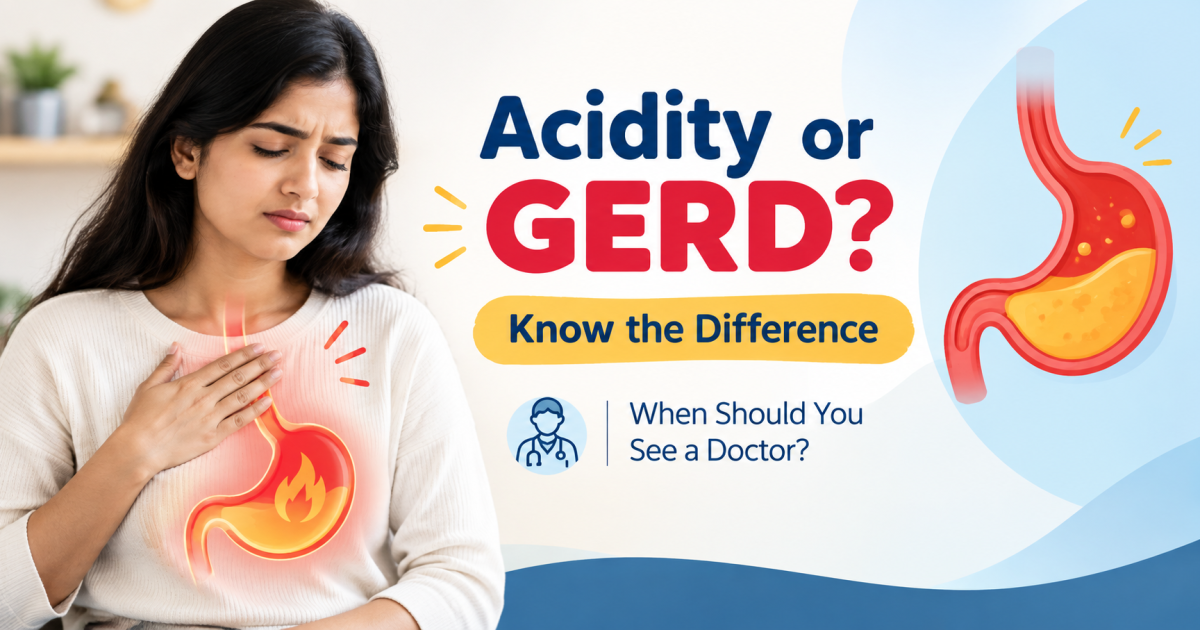
Learn the key differences between acidity and GERD, common symptoms, warning signs, treatment evaluation, and when you should consult a gastroenterologist.
You eat a
heavy plate of biryani, maybe skip your walk, and by 9 pm there's that familiar
burning feeling climbing up from your chest. Most of us just call it
"acidity" and reach for an antacid. And most of the time, that's
exactly what it is — a one-off reaction to a big meal, too much oil, or eating
late and lying down right after.
But not
all burning sensations after eating are the same thing, and not everyone who
feels this once a month has the same condition as someone who feels it four
nights a week. That's really where the acidity vs GERD confusion starts. They
can look almost identical on a bad day, but one is a passing nuisance and the
other is a diagnosis that needs a doctor's attention.
What People Usually Mean by "Acidity"
In
everyday conversation, "acidity" is a catch-all term. It covers the
burning in the chest or upper stomach, the sour taste that comes up the throat,
bloating, a bit of burping, sometimes mild nausea. It usually shows up after
specific triggers — spicy food, too much tea or coffee on an empty stomach,
alcohol, stress, or simply overeating. Take an antacid, avoid the trigger for a
day or two, and it settles down on its own.
This is
technically acid reflux — stomach acid moving up into the food pipe (the
oesophagus) when it isn't supposed to. It happens to almost everyone
occasionally. The stomach lining is built to handle acid; the oesophagus isn't,
which is why it burns when acid touches it.
GERD
stands for gastroesophageal reflux disease. It's what doctors call it when acid
reflux stops being occasional and starts becoming a regular pattern — typically
happening two or more times a week, or frequently enough that it starts
affecting sleep, eating, or day-to-day comfort.
The
difference isn't really about how severe one episode feels. A single bad night
of acidity can feel quite uncomfortable too. The difference is frequency,
persistence, and whether the reflux is starting to cause changes in the food
pipe over time — things like irritation or inflammation of the oesophagal
lining.
Acidity and GERD: How to Tell Them Apart:
It helps
to think of it less as two completely different problems and more as a
spectrum.
Occasional
acidity tends
to:
- Follow a clear trigger (a
specific meal, alcohol, stress)
- Resolve within hours, or
with one antacid dose
- Not repeat for days or weeks
at a stretch
- Not interfere much with
sleep or appetite
GERD tends to:
- Occur regularly, often
without an obvious trigger each time
- Include a sour or bitter
taste in the mouth, especially at night
- Cause a chronic cough,
hoarseness, or throat irritation in some people
- Disturb sleep because lying
flat makes reflux worse
- Sometimes bring on regurgitation
— food or liquid actually coming back up, not just a burning feeling
This is
exactly why people confuse the two. Heartburn — that classic burning behind the
breastbone — happens in both. So does an occasional sour burp. A person having
plain old acidity from last night's party and a person with early GERD can both
walk into a pharmacy asking for the same tablet.
What
separates them isn't a single symptom, it's the pattern. How often does it
happen. Does it happen even on days you've eaten normally. Is it starting to
affect your sleep or your weight or your voice. That pattern is something you
notice over weeks, not after one meal.
Symptoms That Shouldn't Just Be Brushed Off as Routine Acidity:
A few
symptoms are worth paying closer attention to, rather than assuming it's
"just acidity":
- Difficulty swallowing, or
food feeling like it's getting stuck
- Pain while swallowing
- Unexplained weight loss
- Repeated vomiting
- Blood in vomit, or stools
that look black and tarry
- Symptoms that keep getting
worse despite antacids
- Reflux that disturbs sleep
almost every night
And a
separate but important point — chest pain shouldn't automatically be assumed to
be acidity, especially if it's new, severe, or comes with breathlessness,
sweating, dizziness, or pain spreading to the arm or jaw. That combination
needs urgent medical evaluation, not an antacid. Cardiac pain and reflux pain
can genuinely feel similar, and it isn't something to self-diagnose.
If
antacids are working fine once in a while, there's usually no need to rush to a
specialist. But it's worth getting checked by a doctor — often a
gastroenterologist, someone who specialises in digestive system conditions — if
symptoms are happening more than twice a week, have lasted several weeks, keep
coming back after you stop medication, or are accompanied by any of the warning
symptoms above.
A
gastroenterology consultation usually starts with a detailed history — how often
symptoms occur, what triggers them, how they respond to medication, and whether
there are any warning symptoms. In many cases, that's enough to start with a
treatment plan.
Where
symptoms are persistent, unusual, or not responding as expected, doctors may
recommend further tests. An upper GI endoscopy allows a direct look at the food
pipe and stomach lining, using a thin camera, to check for inflammation or
other changes. pH monitoring measures how much acid is refluxing into the
oesophagus over a day. Manometry checks how well the muscles of the oesophagus
are functioning, which matters when reflux is linked to a swallowing or
motility issue rather than just excess acid. Not everyone needs all of these —
the choice depends on what the symptoms suggest.
Lifestyle Habits That Can Help:
None of
these guarantee that reflux won't happen, but they do reduce how often it
occurs for a lot of people: eating smaller meals rather than one large one, not
lying down right after eating, keeping a gap of at least two to three hours
between dinner and bedtime, cutting back on things that are personal triggers
(this varies — for some it's caffeine, for others it's fried food or alcohol),
and managing body weight, since extra weight around the abdomen tends to
increase reflux.
Why Repeated Self-Medication Isn't the Best Long-Term Approach:
It's easy
to keep buying the same antacid or acid-reducing tablet every time symptoms
show up, without really asking why they keep coming back. Occasionally that's
fine. But doing it for months, without understanding whether the underlying
cause is diet, weight, a hiatus hernia, or something else, means the actual
issue never really gets addressed — it just gets papered over each time.
If reflux
symptoms are frequent, getting worse, or starting to affect your sleep,
appetite, or daily routine, it's worth having it looked at properly rather than
treating it as routine acidity indefinitely. Gastroenterology care for this
kind of concern typically involves a clinical evaluation first, with tests like
endoscopy or pH studies brought in only where they're genuinely useful. Amor
Hospitals' Gastroenterology department in Hyderabad handles this kind of
assessment for acid reflux and related digestive concerns, for anyone who feels
it's time to get a proper answer instead of guessing.
FAQs:
1. Is GERD just a more serious form of acidity?
Not exactly "more serious" in terms of pain — it's more about
frequency and pattern. Someone can have very mild but regular reflux that
qualifies as GERD, while someone else can have one intense bout of acidity that
isn't GERD at all. It's the repetition over weeks that matters, not how strong
a single episode feels.
2. How many times a week does reflux need to happen before it's considered GERD?
As a general guide, doctors often look at symptoms occurring two or more times
a week, especially if this continues over several weeks. But this isn't a
strict cutoff — someone with symptoms once a week that are steadily worsening
or disturbing sleep would still be worth getting checked.
3. Can GERD happen without heartburn?
Yes, and this is something people don't always expect. Some people with GERD
mainly get a chronic cough, a hoarse voice, throat clearing, or a sensation of
something stuck in the throat, with very little classic burning. This is
sometimes called silent reflux, and it can be easy to miss because it doesn't
look like typical acidity.
4. Areant acids bad for long-term use?
Occasional use for occasional symptoms is generally fine. The concern is more
about relying on them repeatedly for months without figuring out why the reflux
keeps happening. That's a conversation to have with a doctor rather than
something to decide on your own, since it depends on which medicine, how often,
and what's actually causing the reflux.
5. Does GERD go away on its own with diet changes?
For some people, yes — losing weight, eating smaller meals, and avoiding
personal trigger foods can bring noticeable improvement. But this isn't true
for everyone. Some cases are linked to things like a hiatus hernia or how the
muscle at the bottom of the food pipe is functioning, which diet alone won't
fix. That's exactly why persistent cases need a proper evaluation rather than
just lifestyle trial and error.
6. Is chest pain from GERD dangerous?
Reflux-related chest pain itself isn't usually dangerous, but the problem is
that it can feel very similar to cardiac chest pain. If the pain is new,
severe, or comes with breathlessness, sweating, dizziness, or pain spreading to
the arm or jaw, it needs urgent medical attention first — it shouldn't be
assumed to be acidity until that's ruled out.
7. Do Ineed an endoscopy for acidity?
No, not for ordinary, occasional acidity. An endoscopy is usually considered
when symptoms are persistent, not responding to treatment, associated with
warning signs like difficulty swallowing or weight loss, or when the doctor
needs to check the oesophagal lining directly for inflammation or other
changes.